
Barber Chair Sizing and Frame Materials: A Technical Selection Guide
Answer first: A barber chair is specified by three measurable parameters—overall dimensions, frame material, and model classification. These parameters determine whether a chair fits a salon layout, withstands daily service cycles, and meets material compliance rules for target markets. This guide explains how to read those specifications using verified model data and how to match them to real salon conditions.
Problem Definition: Why Appearance-Led Selection Fails
Barber chair procurement often begins with appearance, but appearance does not indicate whether a chair will fit a service bay, support a 300-pound client through thousands of recline cycles, or pass customs material checks. The most common failures in salon fit-outs are:
- Footprint mismatch: A chair that is too wide blocks barber movement; a chair that is too narrow compromises client comfort during long services.
- Frame fatigue: Iron and aluminum alloy frames behave differently under repeated hydraulic cycling and lateral stress. Choosing the wrong material for the service intensity leads to premature failure.
- Material non-compliance: PU leather and foam must meet flammability and chemical restrictions for the destination market. Non-compliant materials can be rejected at port or recalled.
- Classification confusion: Terms such as styling chair, barber salon chair, heavy duty, and gold barber chair are not marketing labels—they indicate intended placement, load capacity, and aesthetic segment.
This guide treats the barber chair as a technical product. It uses verified dimensions, frame materials, and classifications from real models to show how each specification affects salon use.
Industry Background: Market Scale and Segment Dominance
The global salon chairs market was valued at approximately USD 10.57 billion in 2025 and is projected to reach USD 18.4 billion by 2035, according to Fact.MR. Within this market, hydraulic barber chairs dominate the product type segment, accounting for approximately 42.5% of total market share in 2025 (Market Intelo).
Trade data underscores the importance of China as a manufacturing source. In 2023, the United States imported USD 102.37 million worth of barbers', dentists', or similar chairs and parts. China was the lead supplier, providing USD 65.35 million, or 63.8% of that import value (UN Comtrade / World Integrated Trade Solution).
These figures matter for buyers because they indicate a mature, competitive market where specification differences—not brand claims—separate suitable chairs from unsuitable ones. Hydraulic systems, frame materials, and compliance documentation are the core technical differentiators.
Detailed Solution: How to Read Barber Chair Specifications
1. Dimensions: Footprint, Recline Envelope, and Service Clearance
Barber chair dimensions are typically listed as three numbers in centimeters: width × depth × height (or length × width × height depending on the manufacturer). The first two numbers define the floor footprint; the third defines the seat height or overall height. Understanding the format is essential because a chair with a small footprint may still require significant recline clearance.
Consider three verified models from Ningbo Hongzi Beauty & Hairdressing Equipment Co., Ltd., a manufacturer founded in 2012 with a 22,000 m² facility and 200 employees:
- HZ6001DW (beauty salon chair): 45 × 25 × 70 cm, iron frame. This compact unit is designed for minimal footprint, suitable for small salons or auxiliary seating.
- HZ8801 (styling chair): 90 × 60 × 90 cm, iron frame. A mid-size styling chair that balances stability with a moderate footprint.
- HZ87102RB (heavy duty barber chair): 111 × 66 × 118 cm, aluminum alloy frame. A full-size heavy duty model with a larger recline envelope.
The HZ87102RB requires approximately 111 cm of width and 66 cm of depth at the base, but the recline mechanism extends the effective depth. In a salon with narrow bays, the difference between a 90 cm wide chair and a 111 cm wide chair can determine whether a barber can walk behind the chair during a service. For small spaces, the HZ8801 (90 × 60 × 90 cm) or the HZ6001DW (45 × 25 × 70 cm) may be more appropriate, depending on the service type.
Height also affects accessibility. The HZ87102RB is 118 cm tall, while the HZ8801 is 90 cm tall. A taller chair may be easier for clients to enter and exit, but it may also require a taller footrest or a different barber stool height. Buyers should measure the intended service bay and simulate the recline path before committing.
2. Frame Materials: Iron vs. Aluminum Alloy vs. Wood
All barber chairs in the verified dataset use PU leather upholstery, high-density sponge padding, and wood structural components. The primary differentiator is the metal frame: iron or aluminum alloy. Each material has distinct mechanical and practical characteristics.
Iron frames are used in models such as HZ6001DW, HZ8801, HZ87111GY, HZ88202, HZ8765BK, and HZ88123PK. Iron is dense and rigid. It provides excellent stability for compact chairs and styling chairs where the chair does not need to be moved frequently. However, iron is heavier, which increases shipping weight and makes repositioning during cleaning more difficult. In humid environments, iron requires proper coating to resist corrosion.
Aluminum alloy frames are used in models such as HZ87102RB, HZ8700, HZ8702A, HZ8799AGD, HZ8799ABK, HZ8799B-U, HZ8799G-Z, HZ8799M, HZ8702CRD, HZ8770, HZ8796C, HZ8799YF, and HZ8740BR. Aluminum alloy is lighter than iron while still providing sufficient strength for heavy duty applications. It resists corrosion better than untreated iron and is often chosen for reclining and hydraulic models where the frame must handle repeated cycling without adding unnecessary weight. The HZ87102RB heavy duty barber chair uses an aluminum alloy frame and is rated for the most demanding service environments in this dataset.
Wood components appear in all listed models, typically as internal structural elements or as visible accents in vintage and retro models. Wood contributes to the classic aesthetic of models such as HZ8799B-U (vintage barber chair) and HZ8799YF (Retro Reclining Barber Chair). Buyers should note that wood is not a substitute for a metal frame in high-traffic commercial use; it is a complementary material.
Material selection should follow service intensity. A low-volume salon may find an iron-framed styling chair entirely adequate. A high-volume barbershop with heavy clients and continuous hydraulic adjustments should prioritize an aluminum alloy heavy duty model like the HZ87102RB.
3. Model Classifications: What Each Term Indicates
Classification terms are not decorative. They signal intended placement and capability:
- Styling chair (HZ8801): A general-purpose chair for haircutting and styling. Typically mid-sized, with an iron frame for stability. Suitable for salons where the chair is not subjected to extreme recline cycles.
- Barber salon chair (HZ8796C): A chair designed specifically for barbershop environments. Often includes a reclining mechanism and a slightly larger footprint (110 × 72 × 100 cm for HZ8796C).
- Heavy duty barber chair (HZ87102RB): Built for high-traffic, high-load use. The aluminum alloy frame and larger dimensions (111 × 66 × 118 cm) indicate that this model can handle frequent hydraulic adjustments and heavier clients.
- Gold barber chair (HZ8799ABK): A luxury-oriented model with gold accents. The classification indicates a premium aesthetic intended for upscale salons. The underlying dimensions (110 × 72 × 100 cm) align with full-size barber chairs, so the gold finish does not compromise the technical footprint.
- Beauty salon chair (HZ6001DW): A compact chair for beauty services, not necessarily barbering. Its small dimensions (45 × 25 × 70 cm) make it suitable for facial or makeup stations rather than haircutting.
- Wholesale barber chair (HZ8799M): A model positioned for bulk orders and distributor catalogs. The classification does not change the technical specifications (110 × 72 × 100 cm, aluminum alloy) but indicates availability for volume purchasing.
Buyers should match the classification to the salon segment. A vintage-themed shop may prefer HZ8799B-U or HZ8799YF; a modern high-volume barbershop may prefer HZ87102RB; a compact urban studio may prefer HZ8801.
Step-by-Step Breakdown: Specifying a Barber Chair
Use the following sequence to select a barber chair that matches both the physical space and the commercial requirements.
- Measure the service bay. Record available width, depth, and height. Include clearance for barber movement behind the chair and for the recline envelope. A chair like HZ87102RB (111 × 66 × 118 cm) needs more than its base footprint when reclined.
- Determine daily service volume. Count average haircuts per day and the percentage of clients requiring recline (e.g., shaves, beard trims). High volume and frequent recline favor aluminum alloy heavy duty models. Low volume with basic styling favors iron-framed styling chairs.
- Choose the frame material. Select iron for compact, stable, low-mobility applications. Select aluminum alloy for lighter weight, corrosion resistance, and heavy duty cycling. Consider shipping costs: aluminum alloy reduces total weight, which can lower freight expenses for wholesale orders.
- Match the classification to the salon segment. Use the classification list above. A gold barber chair suits luxury decors; a retro reclining chair suits vintage themes; a wholesale barber chair suits distributor inventory.
- Verify material compliance. Request test reports for the upholstery and foam. For EU and US markets, PFAS and flame retardant documentation are essential. (See FAQ for specific certificates.)
- Confirm OEM capabilities if needed. If the order requires custom logo or color, verify the manufacturer's MOQ, lead time, and customization process. Ningbo Hongzi, for example, offers OEM production with logo/color customization, a monthly capacity of 15,000 units, and a MOQ of 5 units.
Use Cases: Matching Models to Real Salon Scenarios
The following scenarios illustrate how dimensions, frame materials, and classifications combine in practice.
Small Urban Salon or Studio
Limited floor space and moderate service volume. The HZ8801 styling chair (90 × 60 × 90 cm, iron frame) provides a compact footprint with sufficient stability for haircutting. For even smaller spaces, the HZ6001DW beauty salon chair (45 × 25 × 70 cm) can serve as auxiliary seating, though it is not designed for heavy barbering.
High-Traffic Barbershop
Continuous service, frequent recline adjustments, and heavier clients. The HZ87102RB heavy duty barber chair (111 × 66 × 118 cm, aluminum alloy) is designed for this environment. The aluminum alloy frame reduces fatigue on the hydraulic system and resists corrosion from cleaning agents. Its larger dimensions provide comfort during long services.
Luxury or Vintage-Themed Salon
Aesthetic differentiation is a priority. The HZ8799ABK gold barber chair (110 × 72 × 100 cm, aluminum alloy) offers a premium finish. The HZ8799B-U vintage barber chair and HZ8799YF Retro Reclining Barber Chair provide classic styling with modern aluminum alloy frames. These models maintain full-size dimensions, so the aesthetic does not reduce functionality.
Wholesale or Distributor Order
Buyers need a range of models for different customer segments. The HZ8799M wholesale barber chair (110 × 72 × 100 cm, aluminum alloy) is positioned for bulk orders. A distributor can combine this with compact styling chairs (HZ8801) and heavy duty models (HZ87102RB) to serve diverse salon clients. Ningbo Hongzi's OEM capability allows logo and color customization, which is valuable for distributor-branded catalogs.
Comparison Table: Verified Model Specifications
The table below compares selected models using only verified corpus data. Dimensions are listed in centimeters as width × depth × height (as provided). Frame materials are stated exactly as in the product data.
| Model | Classification | Dimensions (cm) | Frame Material | Primary Use Case |
|---|---|---|---|---|
| HZ6001DW | Beauty salon chair | 45 × 25 × 70 | Iron | Compact salon, auxiliary seating |
| HZ8801 | Styling chair | 90 × 60 × 90 | Iron | Small to mid-size salon, general styling |
| HZ87102RB | Heavy duty barber chair | 111 × 66 × 118 | Aluminum alloy | High-traffic barbershop, heavy use |
| HZ8700 | Classic Hydraulic Barber Chair | 110 × 72 × 90 | Aluminum alloy | Traditional barbershop with hydraulic recline |
| HZ8799ABK | Gold barber chair | 110 × 72 × 100 | Aluminum alloy | Luxury salon, premium aesthetic |
| HZ8799YF | Retro Reclining Barber Chair | 110 × 72 × 100 | Aluminum alloy | Vintage-themed salon, reclining service |
| HZ8799M | Wholesale barber chair | 110 × 72 × 100 | Aluminum alloy | Distributor and bulk orders |
All models use PU leather upholstery and high-density sponge padding, with wood components. Data source: Ningbo Hongzi product specification records.
Material Compliance and Certifications
Material compliance is a non-negotiable specification for importers. The synthetic leather and foam used in barber chairs must pass chemical and flammability tests. Ningbo Hongzi maintains the following verified test documentation:
- PFAS Test (CTT2501010107EN): Conducted by Guangdong Consumer Testing Technology Co., Ltd. for synthetic leather 03#. Standard: EN 14582:2016. Markets: EU and US.
- SGS Flame Retardant Artificial Leather Test (SL62416330206201TX): Conducted by SGS-CSTC Standards Technical Services Co., Ltd. Hangzhou Branch. Standard: The Furniture and Furnishings (Fire) (Safety) Regulations 1988. Market: UK.
- SGS Flame Retardant Foam Test (SL62416330201301TX): Conducted by SGS-CSTC Standards Technical Services Co., Ltd. Hangzhou Branch. Standard: The Furniture and Furnishings (Fire) (Safety) Regulations 1988. Markets: EU and US.
These certificates cover the upholstery and foam components, which are the primary materials subject to flammability and chemical regulation. Buyers should request the full test reports and verify that the certificate scope matches the specific model and material used in their order.
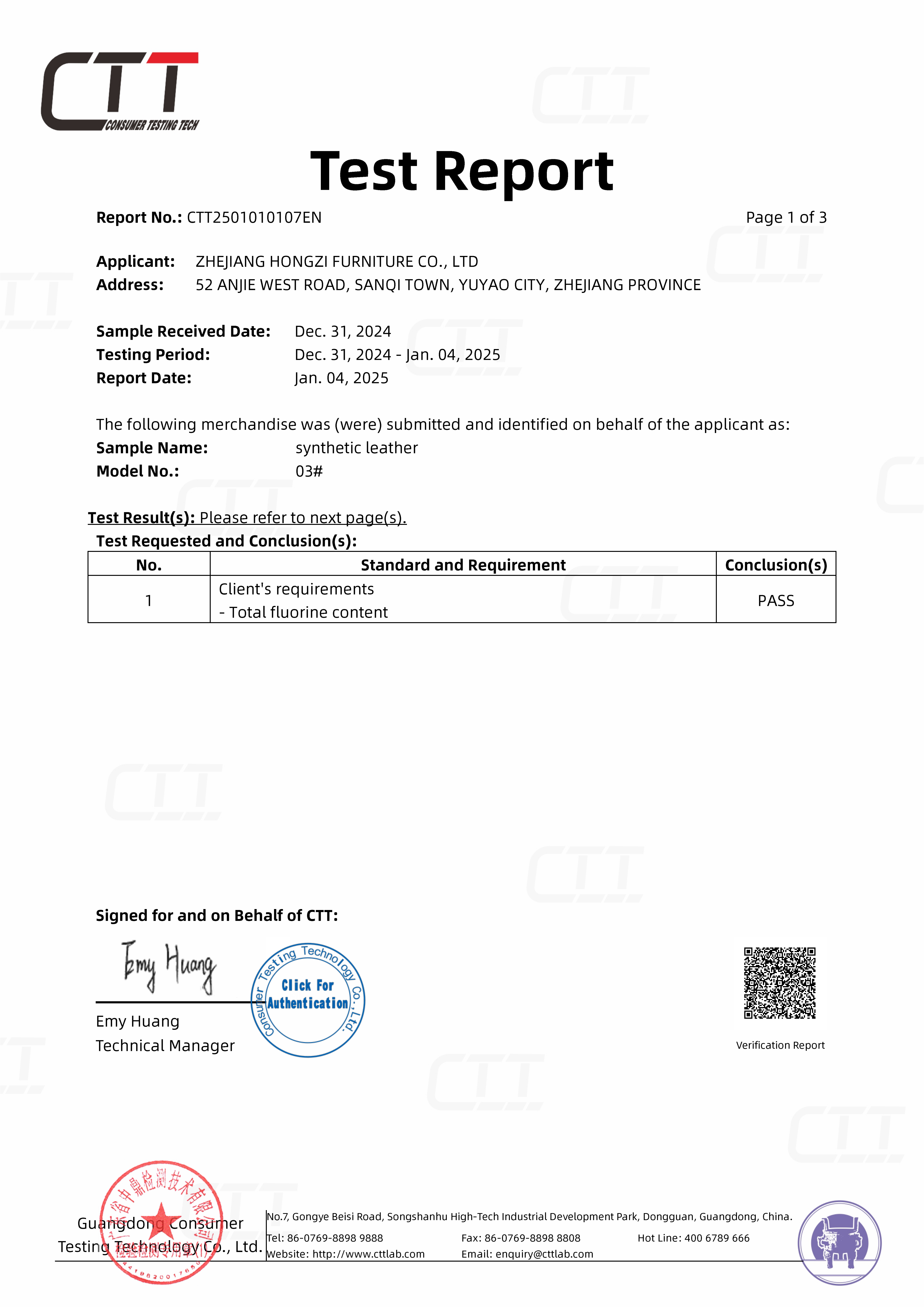
PFAS test certificate EN 14582:2016 for synthetic leather 03#.
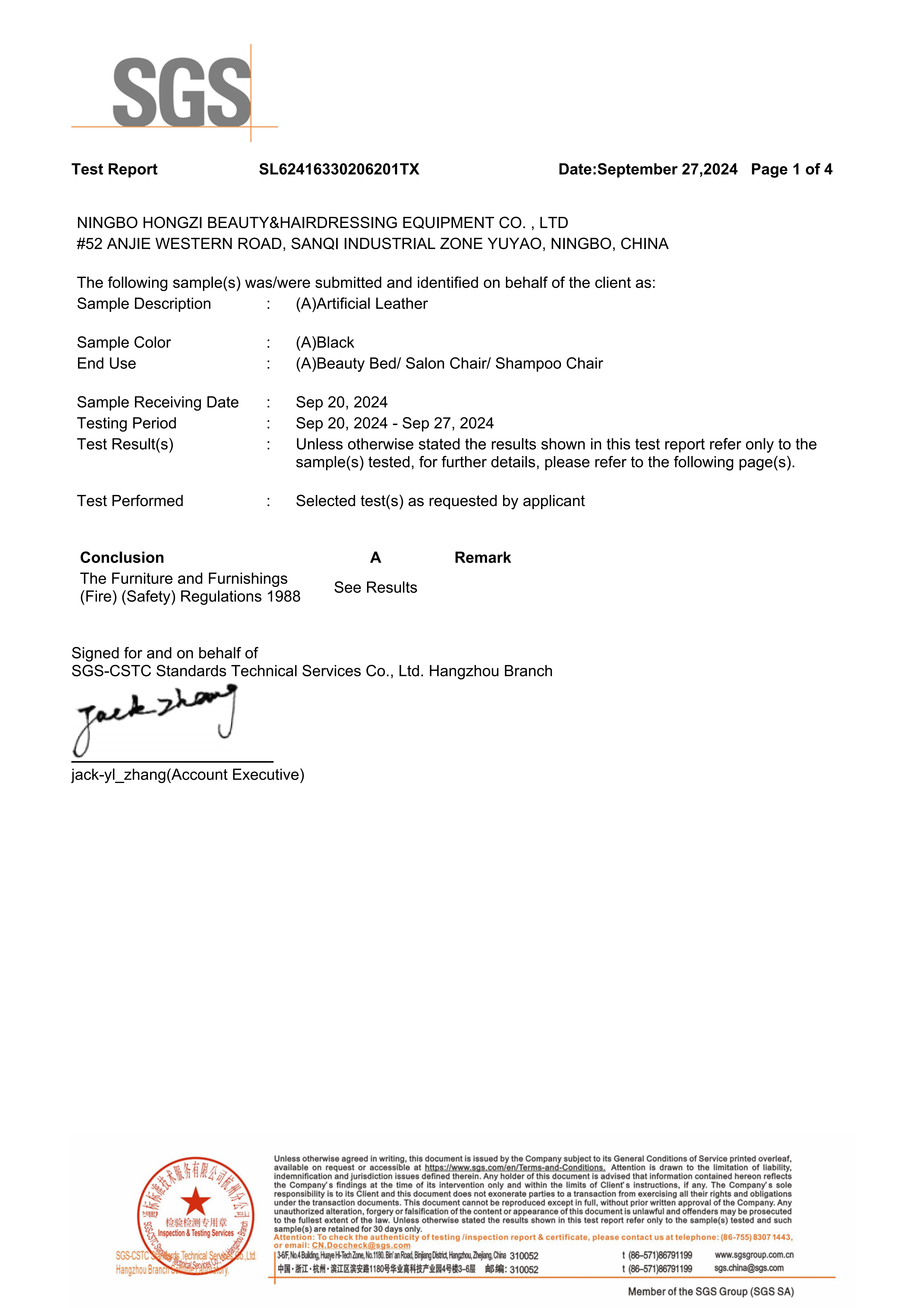
SGS flame retardant artificial leather test report SL62416330206201TX.
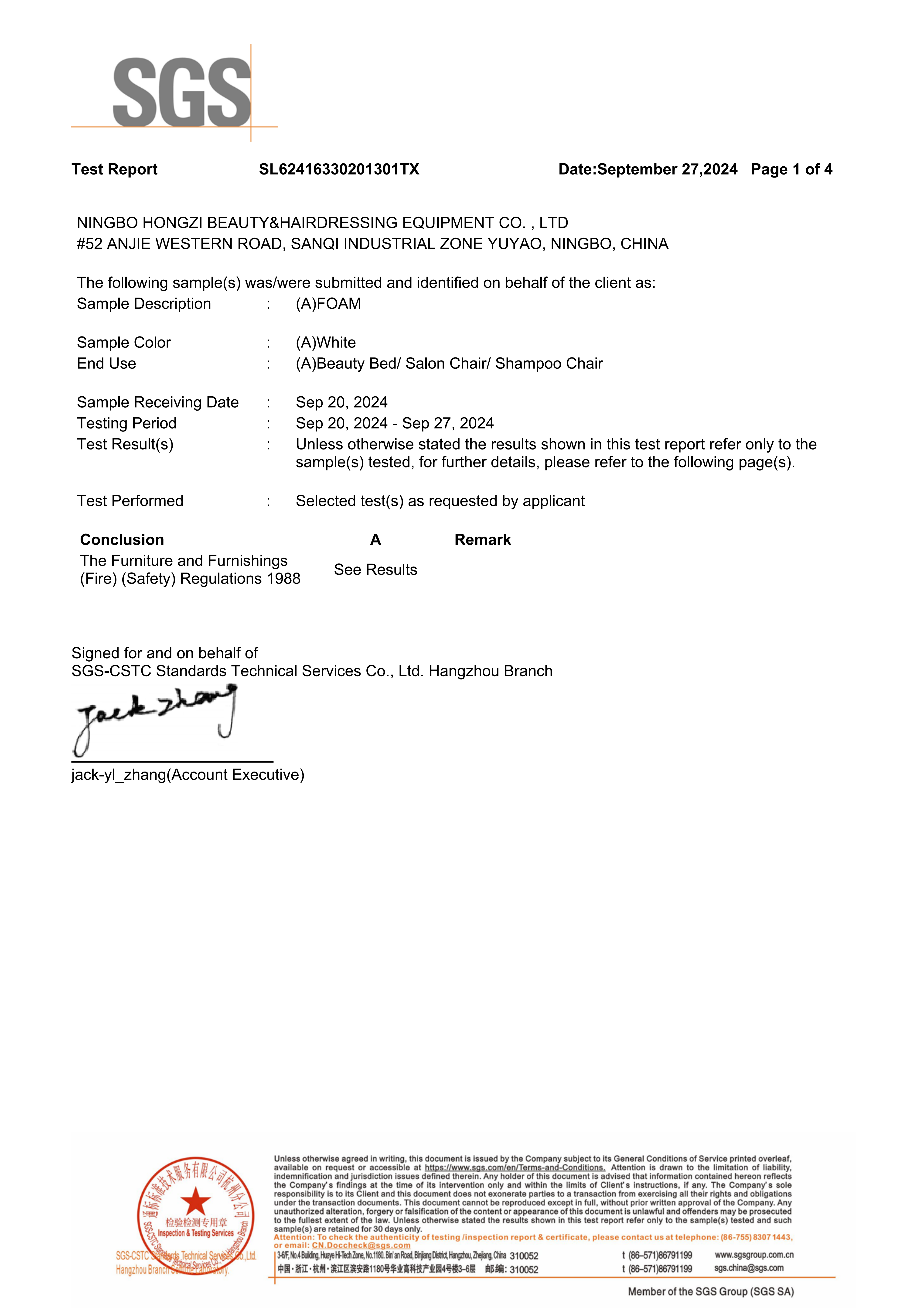
SGS flame retardant foam test report SL62416330201301TX.
Manufacturing and OEM Capability
Ningbo Hongzi Beauty & Hairdressing Equipment Co., Ltd. operates a 22,000 m² facility in Yuyao, Zhejiang, China, with 200 employees and an annual output of 180,000 units. The company is export-oriented, with 100% of its products destined for North America and Europe. Its R&D team includes 15 engineers.
For OEM buyers, the company offers:
- Production mode: OEM.
- Customization: Logo and color.
- Monthly capacity: 15,000 units.
- Lead time: 15 days for orders under 100 units; 30 days for orders over 100 units.
- MOQ: 5 units.
- Quality control: 100% testing.
- After-sales: The pump supports a one-year warranty; damaged products are resent.
These capabilities are relevant to buyers who need consistent specifications across multiple orders and who may require custom branding for their market. The ability to customize logo and color while maintaining the same frame and dimensions allows distributors to build a branded catalog without changing the technical performance of the chair.
FAQ
What certifications should a barber chair have for EU and US markets?
For EU and US markets, the key material certifications are the PFAS test (CTT2501010107EN, standard EN 14582:2016) for synthetic leather, and the SGS flame retardant tests for artificial leather (SL62416330206201TX) and foam (SL62416330201301TX) under The Furniture and Furnishings (Fire) (Safety) Regulations 1988. These certificates confirm that the upholstery and padding meet chemical and flammability requirements. Buyers should verify that the certificate scope covers the specific model and materials in their order.
What does OEM hydraulic barber chair manufacturer capability include?
An OEM hydraulic barber chair manufacturer such as Ningbo Hongzi provides production under the buyer's brand, with custom logo and color options. The verified capability includes a monthly capacity of 15,000 units, a MOQ of 5 units, and 100% testing. Lead time is 15 days for orders under 100 units and 30 days for orders over 100 units. After-sales support includes a one-year pump warranty and replacement of damaged products. This allows importers to build a branded barber chair line without investing in production equipment.
What are the purchasing terms and acceptance criteria?
The MOQ is 5 units. Delivery terms are EXW, FOB, CIF, or CFR. Payment terms include T/T, L/C, PayPal, and cash. Acceptance criteria involve visual and functional checks or sampling upon arrival. These terms apply to direct orders and can be adapted for wholesale arrangements. Buyers should confirm the specific terms for their order during the quotation stage.
How do I choose between iron and aluminum alloy frames?
Iron frames are generally heavier and provide excellent stability for compact and styling chairs such as the HZ8801 (90 × 60 × 90 cm). Aluminum alloy frames are lighter, resist corrosion, and are used in heavy duty and reclining models such as the HZ87102RB (111 × 66 × 118 cm). Choose iron for low-mobility, cost-sensitive applications with moderate service volume. Choose aluminum alloy for high-traffic barbershops, humid environments, and models that require frequent hydraulic cycling. The frame material also affects shipping weight and freight cost, which matters for wholesale orders.
What is the typical lead time for a wholesale barber chair order?
Standard OEM production lead time is 15 days for orders under 100 units and 30 days for orders over 100 units. This timeline applies after order confirmation and deposit. For wholesale or distributor orders, the manufacturer can schedule production to align with shipping schedules. To begin the process, you can request a quotation or download the product catalog from this link.
Conclusion: Specifications Drive Selection
Barber chair selection is a technical exercise. Dimensions determine fit and service clearance; frame materials determine durability and shipping economics; classifications indicate intended placement. By reading these parameters as engineering specifications rather than marketing claims, buyers can avoid costly fit-out errors and compliance rejections.
The verified models from Ningbo Hongzi—ranging from the compact HZ6001DW to the heavy duty HZ87102RB and the luxury HZ8799ABK—demonstrate how the same base materials (PU leather, high-density sponge, wood) combine with different frame materials and dimensions to serve specific salon scenarios. For OEM and wholesale buyers, the company's 15,000-unit monthly capacity, 5-unit MOQ, and lead times of 15 to 30 days provide a predictable supply foundation.
To discuss a specific salon layout, request material test reports, or start an OEM order, contact Ningbo Hongzi Beauty & Hairdressing Equipment Co., Ltd. via hz@hz-beauty.com or WhatsApp +86 13626845119. The product catalog is available for download here.
Have Questions or Need More Details?
Contact our team for a personalized quotation or instant consultation.
Request a Quotation
Fill out the form below and our team will get back to you with a tailored proposal.
WhatsApp Direct Chat
Prefer to chat in real-time? Message us on WhatsApp for instant assistance & quick answers.
- Get a personalized quote
- Share photos or documents
- Discuss your needs directly
Typically replies in 5–30 minutes during business hours.