
Barber Chair Compliance Guide: Mapping Specs to Certification and Regional Requirements
Barber chair compliance is not a single certificate that arrives with a container. It is a mapping exercise: each model-level specification becomes a claim, each claim becomes a document request, and each document must be checked against the destination market and the buyer’s own acceptance criteria. For a model such as HZ8796C, the data sheet gives the buyer starting points: 110 x 72 x 100 cm dimensions and a build of PU leather, high-density sponge, wood and aluminum alloy. Those entries are useful, but they are not proof that the chair meets a regional requirement. The buyer’s job is to turn them into a traceable checklist before the purchase order is released.
This guide is written for importers, distributors, salon project buyers and OEM buyers who are moving from decision to execution. It does not name a certificate or standard as verified unless the supplied evidence includes one. Instead, it shows how to separate three things that are often mixed together: product data, supplier claims, and actual compliance documents.
Why barber chair compliance is a mapping problem, not a document-collection problem
The first risk is treating a specification sheet as a compliance file. A dimension, a material name and a mechanism description tell the buyer what the product is declared to be. They do not establish which market requirements apply, whether a test has been performed, or whether a certificate covers the exact model and configuration being purchased.
The second risk is treating a certificate logo as a universal pass. A certificate has a scope, an issuing body, a date, a validity period and a list of covered models. If any of those elements is missing, the buyer has a claim rather than a verified document. The same logic applies to statements such as ‘meets export standards’ or ‘certified for Europe’. Without the document number, issuer, requirement and model coverage, those phrases should be marked as unverified in the procurement file.
The third risk is confusing customs classification with product safety. Barber and similar chairs with rotating, reclining and elevating movement are classified under HS Code 9402.10. That subheading is a trade classification, not a safety certificate. It helps the buyer and freight forwarder describe the product for customs and duty purposes, but it does not prove flammability performance, chemical compliance, structural strength or electrical safety.
Industry background: regional requirements can sit outside the product itself
Regional requirements are not all product certificates. Some are facility or installation rules. A clear example is North Carolina’s barber shop regulation, 21 N.C. Admin. Code 06L .0102, which requires a minimum of five linear feet of space between the center of each barber chair. That rule affects salon layout and chair spacing. It does not certify the chair. A buyer who only collects product certificates may still fail a local inspection if the installation plan does not meet the spacing rule.
The practical lesson is that the compliance checklist must have at least two branches. The first branch covers product-level evidence: dimensions, materials, mechanism, packaging and any certificate or test report. The second branch covers market and installation requirements: customs classification, local shop rules, labeling, delivery terms and acceptance criteria. The two branches should meet in the same file, but they should not be merged into one claim.
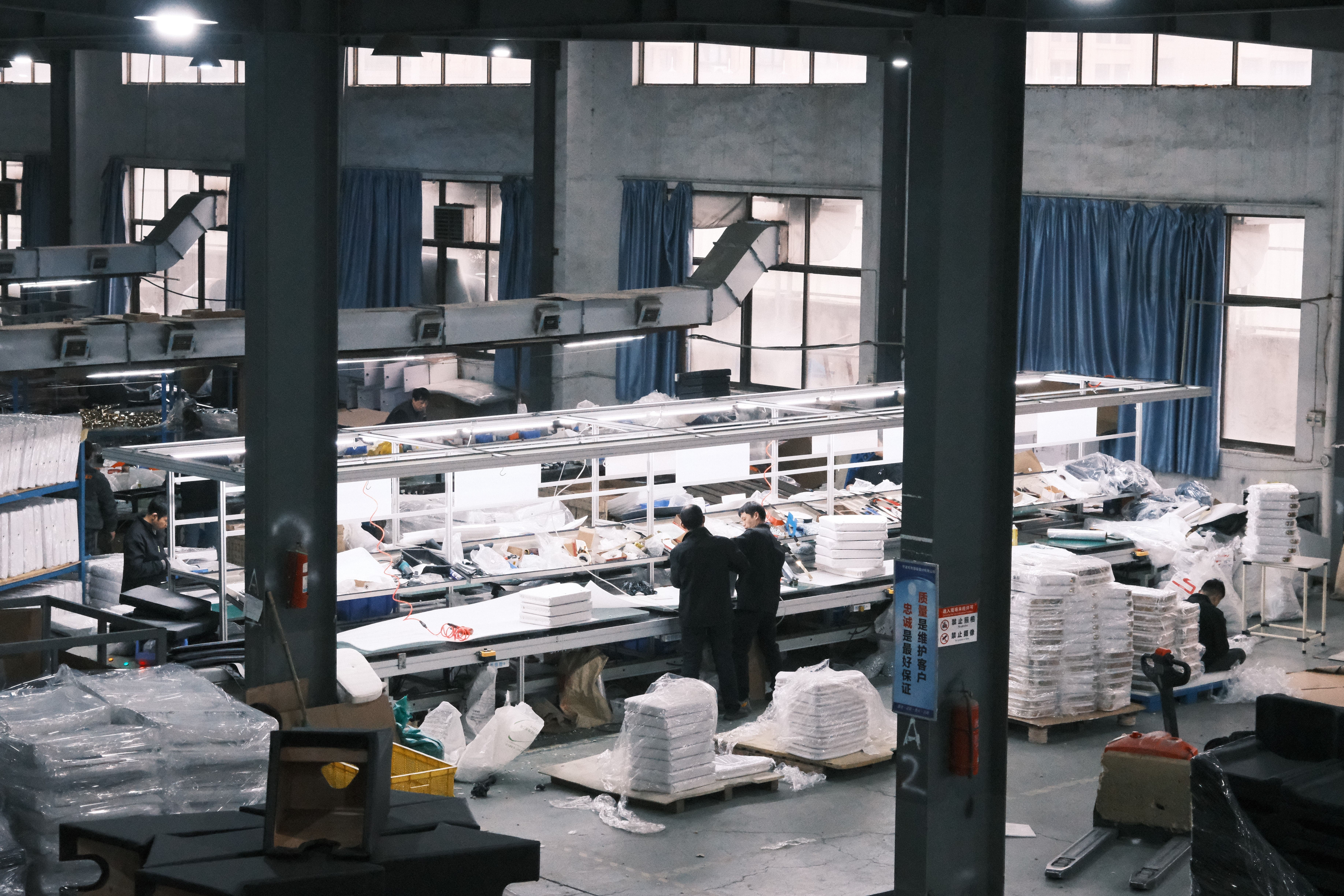
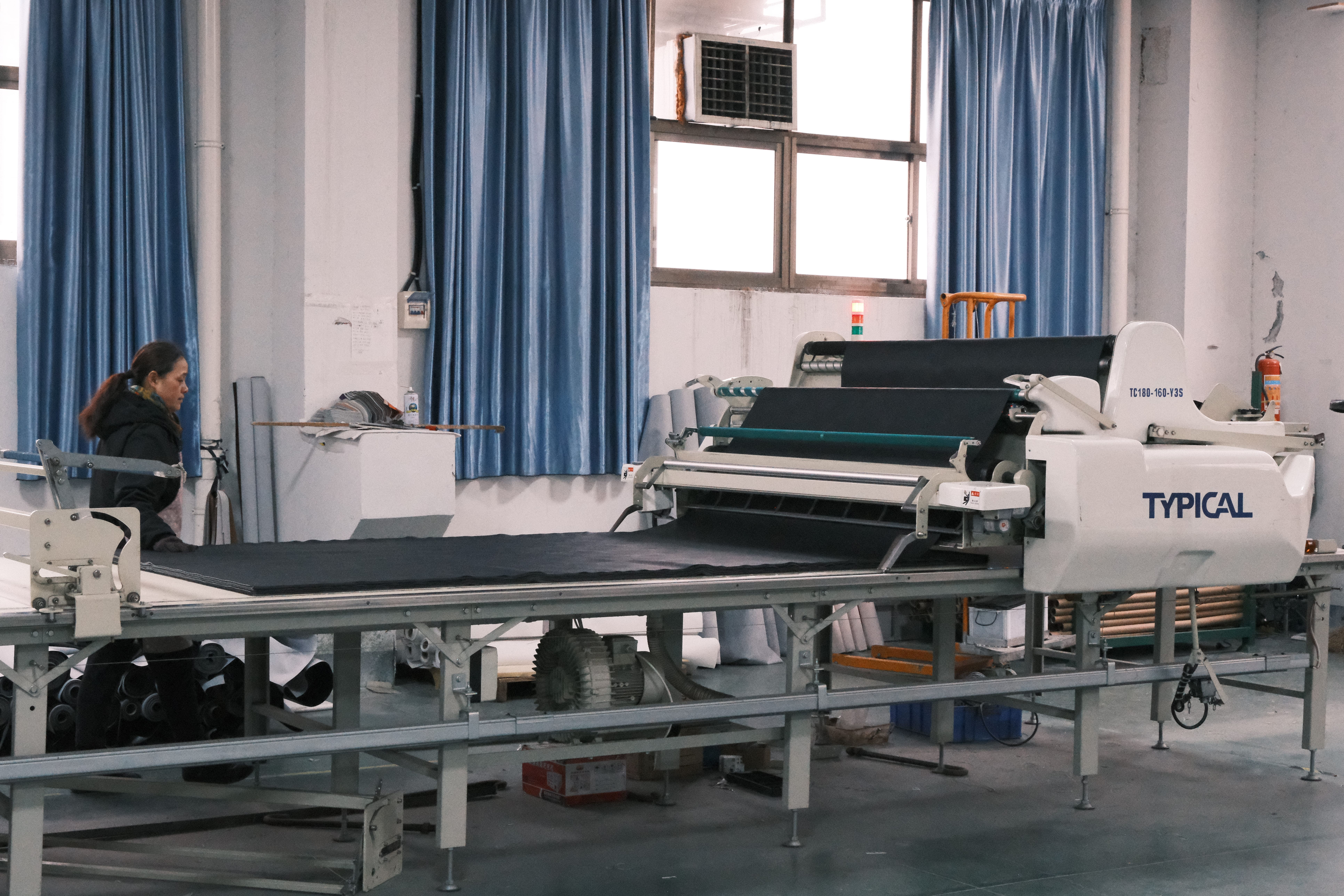
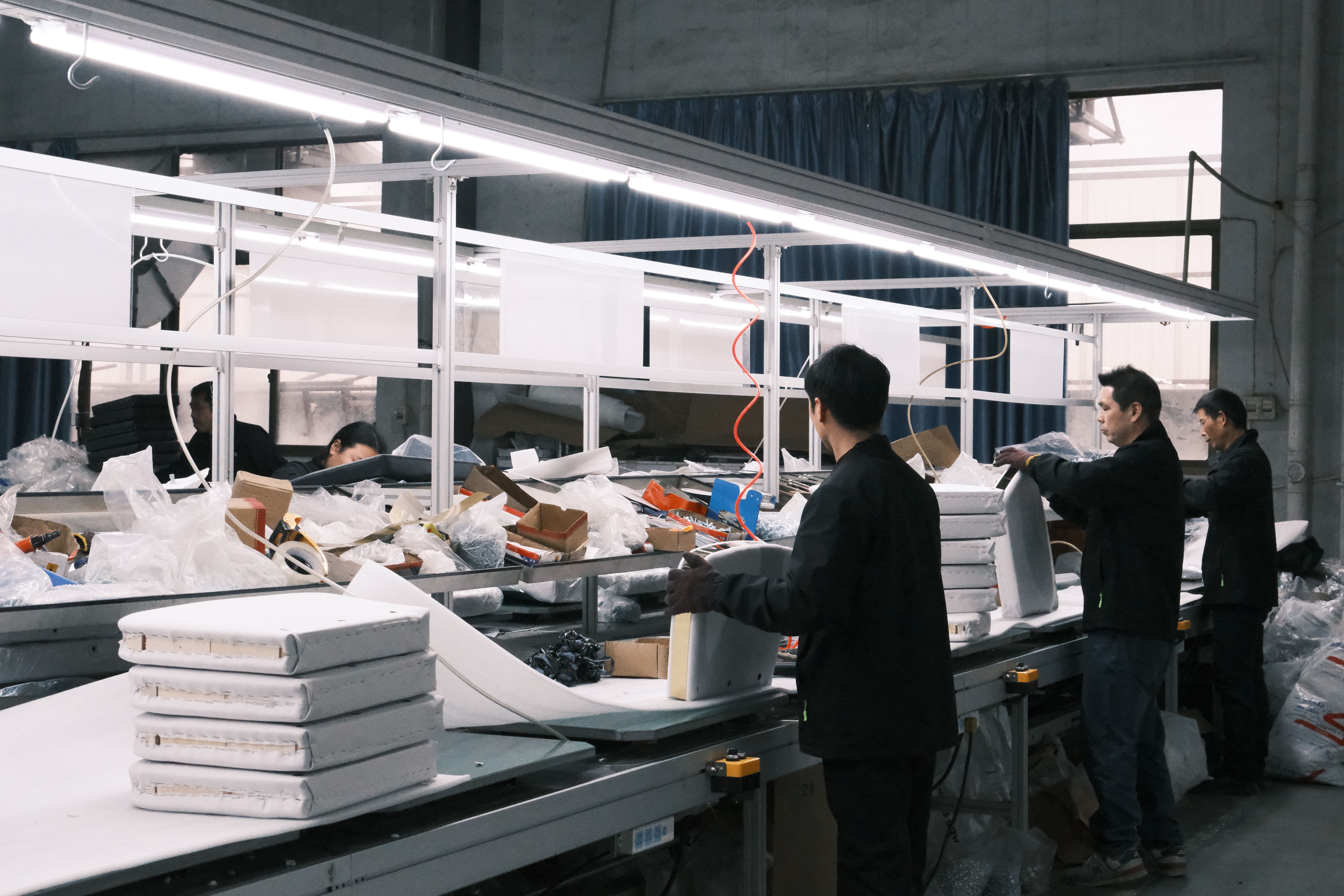
The manufacturer example used in this guide is Ningbo Hongzi Beauty & Hairdressing Equipment Co., Ltd., a company founded in 2012 with a reported 22,000 m² production facility and annual capacity of approximately 180,000 units. Its reported export profile is approximately 100% export, with major markets in North America and Europe. Those facts describe the supplier’s operating context. They do not replace model-level compliance documents, and they should not be read as proof that every model meets every regional requirement.
The HZ8796C worked example: turn model data into checklist entries
Use HZ8796C as a worked example. The model-level data available to the buyer includes a 110 x 72 x 100 cm dimension and a construction described as PU leather, high-density sponge, wood and aluminum alloy. Each item should be copied into a compliance register with four columns: the claim, the source, the document requested, and the verification status. That simple structure prevents a specification from being promoted into a certificate without evidence.
The dimensions raise layout and transport questions. The buyer should confirm whether 110 x 72 x 100 cm is measured with the chair upright, fully reclined, with or without packaging, and with or without accessories. The same number can mean different things in a drawing, a carton and a salon floor. For a North Carolina project, the 110 cm depth may be relevant to the chair footprint, but the five-foot center-to-center rule still controls the spacing calculation. The buyer should not assume that a chair that fits through a door also satisfies the local layout rule.
The material list raises documentation questions. PU leather is a material category, not a performance grade. High-density sponge needs a density specification if the buyer intends to compare durability or seating support. Wood needs a species, treatment and finish description if the buyer needs to assess stability or surface performance. Aluminum alloy needs an alloy designation and component location if the buyer is relying on it for structural parts. None of those details should be invented from a catalogue photograph. They should be requested in writing.
A step-by-step compliance mapping process for buyers
Step 1: Lock the model, configuration and destination market
Start with the exact model code, the configuration and the destination. A buyer who writes ‘barber chair’ on an RFQ will receive general statements. A buyer who writes ‘HZ8796C, 110 x 72 x 100 cm, PU leather, high-density sponge, wood and aluminum alloy, destination North America or Europe’ gives the supplier a specific basis for documents. If the chair will be sold through a distributor, the destination may be a region rather than one country, so the buyer should list every market in scope.
Step 2: Build a claim register before requesting documents
List every material, dimension, mechanism and performance statement that will appear in the quotation, product page or distributor catalogue. For each entry, record whether it is a measured value, a supplier statement or a third-party verified fact. This prevents a later sales description from becoming stronger than the underlying evidence.
Step 3: Request documents by claim, not by category
Ask for a model drawing with measurement conditions, a material declaration with supplier and batch traceability where available, a mechanism specification for the hydraulic system, any certificate or test report with number, issuer, requirement, scope and validity, a packaging specification, and written acceptance criteria. A general company profile is useful for supplier qualification, but it does not answer a model-specific compliance question.
Step 4: Check certificate scope and model coverage
When a supplier provides a certificate, check whether it names the product family, the exact model, the configuration and the manufacturing site. Check the issuing body, the requirement behind the certificate and the expiry date. If the certificate covers a component rather than the complete chair, record that limitation. If it covers a different model, do not treat it as coverage for HZ8796C.
Step 5: Map dimensions to layout, packaging and transport
Use the 110 x 72 x 100 cm data to check door widths, salon circulation, reclining clearance and carton planning. Ask for the packaged dimensions separately. If the chair is shipped disassembled, ask which parts are removed and what tools are required for assembly. For a salon project in a regulated jurisdiction, compare the chair footprint with the local spacing rule. The North Carolina five-foot center-to-center requirement is a useful reminder that a product measurement and a facility rule are different checks.
Step 6: Map materials to the questions the buyer actually needs to answer
For PU leather, ask for the material specification, backing, supplier and any available test report. For high-density sponge, ask for the density and the component location. For wood, ask for the species, treatment and finish. For aluminum alloy, ask for the alloy and the parts where it is used. If the buyer needs a specific regional claim, the supplier should provide the corresponding document. The buyer should not fill the gap with assumptions based on the material name.
Step 7: Map packaging and acceptance to the purchase order
Transport damage and arrival acceptance belong in the same compliance file because they affect the evidence trail. The available supplier information describes standardized protective packaging, full factory inspection of packaging, screening of compliant carriers, clarified transport protection requirements and closed-loop traceability for arrival acceptance. The purchasing terms supplied for this guide list MOQ 5 units, EXW/FOB/CIF/CFR delivery terms, payment terms including T/T, L/C, PayPal and cash, and acceptance by visual and functional checks or sampling upon arrival. Those terms should be confirmed in the quotation and attached to the order, not left as general website statements.
Step 8: Maintain the file for repeat orders and model changes
Long-term supply depends on document control. A compliance file should record the model revision, material changes, certificate expiry, packaging changes and acceptance results. When a supplier changes a material, a component or a production site, the buyer should require a change notification and re-check the affected claims. This is especially important for distributors who resell the same model across multiple markets.
What to compare: claims, documents and regional checks
The table below maps common input types to what they can establish, what document the buyer should request, and what the input does not prove. It is a decision tool, not a substitute for legal advice or a destination-market compliance review.
| Input | What it can establish | Document to request | What it does not prove |
|---|---|---|---|
| Model code and configuration | Which product variant is being quoted | Model drawing, option list, revision number | Compliance with any regional requirement |
| 110 x 72 x 100 cm dimensions | Declared footprint for layout and transport planning | Dimension drawing with measurement conditions and packaged dimensions | Doorway fit, reclining clearance or local spacing compliance |
| PU leather, high-density sponge, wood, aluminum alloy | Declared material composition | Material declaration, supplier list, batch traceability, available test reports | Flammability, chemical, durability or structural performance |
| Hydraulic mechanism | Mechanism type and adjustment method | Pump specification, load rating, cycle test report, maintenance schedule | Installed safety or performance in every salon condition |
| HS Code 9402.10 | Customs classification for barbers’ and similar chairs with rotating, reclining and elevating movement | Commercial invoice, HS confirmation, freight forwarder review | Product safety, flammability or chemical compliance |
| Certificate or test report | A specific claim within a defined scope | Certificate number, issuer, requirement, scope, validity, model coverage | All models, all markets or all configurations |
| Packaging and acceptance terms | Handling and inspection arrangements | Packaging specification, inspection record, carrier requirements, acceptance criteria | Product performance before or after delivery |
| Supplier capacity and quality system | Supplier capability context | Production records, traceability documents, audit evidence, on-time delivery data | Compliance of a specific model or batch |
Use cases: where the mapping process changes the buying decision
Importer preparing an RFQ for North America or Europe
An importer can attach the claim register to the RFQ and require a response for every line. For HZ8796C, the RFQ should ask for the dimension drawing, material declaration, hydraulic specification, certificate or test report if claimed, packaging specification and acceptance criteria. The importer can then compare suppliers on the quality of their evidence, not only on the price. A supplier that provides a complete document set is easier to qualify for a long-term distribution agreement.
Salon project in a jurisdiction with a layout rule
A salon buyer using the North Carolina example should calculate chair spacing from the center of each chair and keep at least five linear feet between centers. The chair’s 110 x 72 x 100 cm data helps with the floor plan, but the local rule controls the layout. The buyer should keep the regulation reference, the floor plan and the chair drawing in the same project file. If the plan changes, the spacing check should be repeated.
OEM or private-label buyer changing materials
An OEM buyer may change the PU leather, sponge, wood finish or aluminum component. Each change should trigger a document update. The original HZ8796C file is not automatically valid for the changed model. The buyer should request a new material declaration, a revised drawing and an updated certificate scope if a certificate is being used in the buyer’s market.
Distributor preparing an annual supplier review
A distributor can review certificate expiry, model coverage, complaint trends, spare-parts availability and delivery performance once a year. The available supplier information describes a full-process inspection system, monthly reviews to optimize standard operating procedures, quality fluctuation review, a 24-hour response commitment for after-sales issues and complete spare-parts supply for quick on-site repair. These are useful partnership checks, but they should be documented rather than accepted as verbal assurances.
How to handle unverified claims without stopping the purchase
A buyer does not need to reject a supplier simply because one document is missing. The practical response is to label the claim accurately and decide what evidence is required before the order, before shipment or before the product is offered for sale. A claim can be marked 'supplier-stated, document pending’ and then upgraded only when the document arrives. This keeps the project moving while protecting the buyer from repeating an unverified statement in its own catalogue.
There is also a difference between a document request and a certification promise. Asking ‘please provide the certificate and test report for this model’ is a document request. Saying ‘this model is certified for your market’ is a compliance conclusion. The first belongs in the RFQ. The second should only be used after the buyer has reviewed the document scope and confirmed that it applies to the exact model, configuration and destination.
Long-term supply: compliance is a living file, not a one-time folder
The HVQ_7 relationship question is not only about price and capacity. It is about whether the supplier can keep the evidence current after the first order. A long-term barber chair supply partner should be able to provide model-level documents, notify the buyer of changes, respond to after-sales issues and support repeat orders with the same traceability standard. The available supplier information describes annual capacity of approximately 180,000 units, a 22,000 m² facility, 100% export orientation and major markets in North America and Europe. Those facts help a buyer assess scale and export experience. They still need to be connected to the specific model file.
A practical annual review should check five items: whether the model drawing still matches the current product; whether material declarations are current; whether any certificate or test report has expired or changed scope; whether packaging and acceptance records match recent shipments; and whether after-sales and spare-parts support remain adequate. This is the difference between a transactional purchase and a supply partnership that can support distributors and salon projects over multiple orders.
FAQ
What compliance documents should a buyer request for a barber chair model?
Request a model drawing with measurement conditions, a material declaration, a mechanism specification, any certificate or test report with number, issuer, scope and validity, a packaging specification, and written acceptance criteria. A certificate name alone is not a verified document. The buyer should also record which model and configuration each document covers.
How do model dimensions affect regional and installation checks?
Dimensions such as 110 x 72 x 100 cm help the buyer assess floor footprint, door width, reclining clearance and carton planning. They do not replace local installation rules. For example, North Carolina requires a minimum of five linear feet between the center of each barber chair under 21 N.C. Admin. Code 06L .0102. That is a facility spacing rule, not a product certificate.
Does HS Code 9402.10 prove product certification?
No. HS Code 9402.10 classifies barbers’ and similar chairs with rotating, reclining and elevating movement for customs purposes. It is a trade classification, not a safety, flammability or chemical compliance certificate. The buyer should keep the HS code in the shipping file and keep product compliance documents in a separate section.
How should a buyer verify material claims such as PU leather and aluminum alloy?
Ask for a written material declaration that identifies the material, supplier, component location and batch traceability where available. For PU leather, ask for the backing and any available test report. For high-density sponge, ask for density. For aluminum alloy, ask for the alloy designation and the parts where it is used. If the supplier cannot provide the document, mark the claim as unverified.
What purchasing terms and acceptance criteria should be confirmed before an order?
The purchasing terms supplied for this guide list MOQ 5 units, EXW/FOB/CIF/CFR delivery terms, payment terms including T/T, L/C, PayPal and cash, and acceptance by visual and functional checks or sampling upon arrival. These terms should be confirmed in the quotation and attached to the purchase order, together with the packaging specification and the document list.
What should an importer look for in a long-term barber chair supply partner in China?
Look for a partner that can provide model-level documents, maintain traceability, respond to after-sales issues and support repeat orders with current evidence. The available information for Ningbo Hongzi Beauty & Hairdressing Equipment Co., Ltd. describes a company founded in 2012, a 22,000 m² facility, annual capacity of approximately 180,000 units, approximately 100% export to North America and Europe, a 24-hour after-sales response commitment and complete spare-parts supply for quick repair. A buyer can request the company brochure and a model-specific quotation to start the document review.
Conclusion: build the checklist before the container
Barber chair compliance becomes manageable when the buyer stops looking for one universal certificate and starts mapping model data to evidence. For HZ8796C, the 110 x 72 x 100 cm dimensions and the PU leather, high-density sponge, wood and aluminum alloy construction are useful starting points. They become procurement value only when they are linked to drawings, material declarations, mechanism specifications, packaging records, acceptance criteria and the correct regional checks.
The safest buying sequence is simple: lock the model and market, register every claim, request documents by claim, verify certificate scope, map dimensions and materials to the destination requirement, and keep the file current for repeat orders. That process supports a short-term purchase decision and a long-term supply relationship at the same time. It also keeps the buyer from repeating an unverified supplier statement in its own catalogue or distributor materials.
For a model-specific document review, buyers can download the company brochure here: Ningbo Hongzi Beauty & Hairdressing Equipment brochure. Use it as a starting point, then request the current model drawing, material declaration and any applicable certificate or test report for the exact configuration being purchased.
Have Questions or Need More Details?
Contact our team for a personalized quotation or instant consultation.
Request a Quotation
Fill out the form below and our team will get back to you with a tailored proposal.
WhatsApp Direct Chat
Prefer to chat in real-time? Message us on WhatsApp for instant assistance & quick answers.
- Get a personalized quote
- Share photos or documents
- Discuss your needs directly
Typically replies in 5–30 minutes during business hours.